 Tampa Siding
 Why Westchase Siding Takes a Beating
Westchase sits inland from Tampa Bay but still gets the full weather package that comes with living in Hillsborough County: long summer stretches of intense UV exposure, sudden afternoon thunderstorms that drive rain sideways into exterior walls, and the real possibility of tropical storm or hurricane-force wind loading every season. None of that is unique to any one street or subdivision in the area, but it adds up differently on siding than it does on a roof or a driveway, because siding is a thin protective skin that has to keep moving air and water out while absorbing direct sun for years at a stretch.
Homes in this part of the county are mostly a mix of stucco, vinyl, older wood-based siding products, and increasingly fiber cement, often installed during the same building boom years, which means a lot of Westchase houses are hitting a similar age where trim, panel seams, and corner boards start showing their history at the same time. Salt-laden air drifting in from the Gulf and the Bay doesn't skip inland neighborhoods entirely — it just works more slowly and less obviously, quietly accelerating corrosion on fasteners and metal trim long before it's visible from the street.
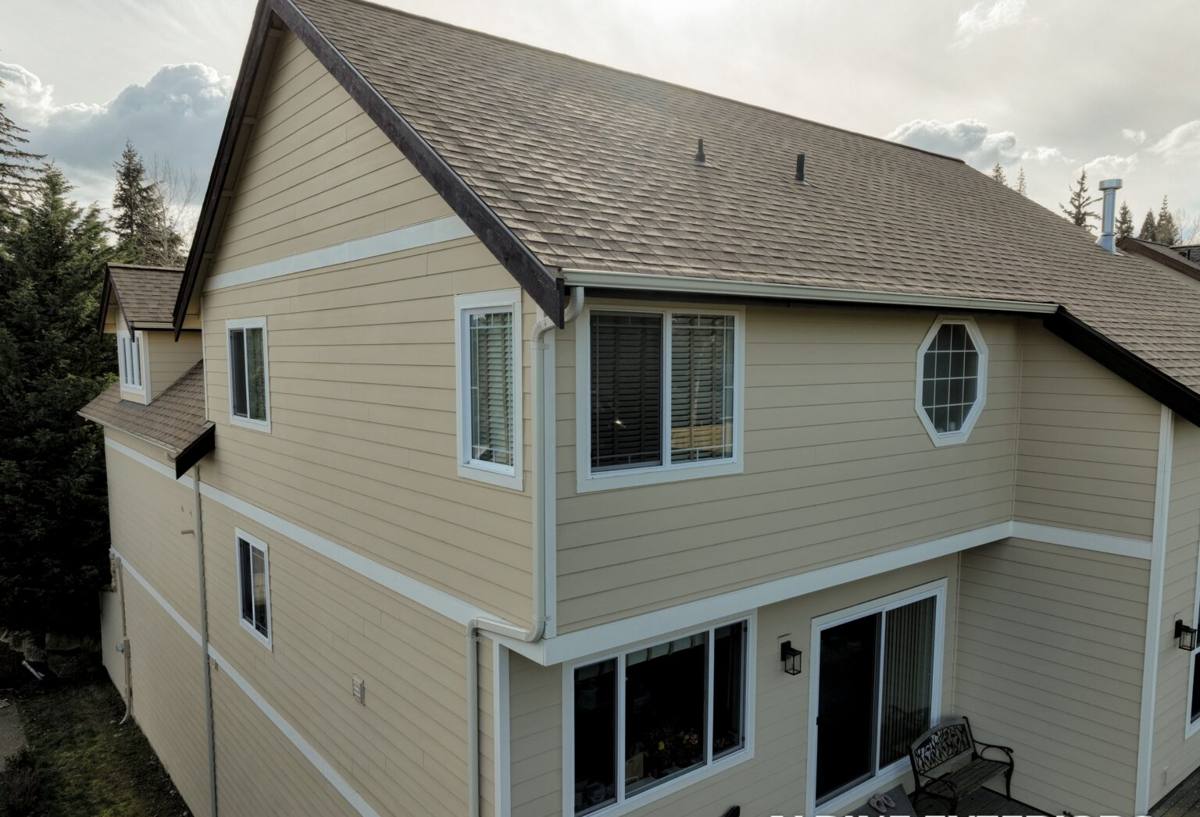
What Siding Damage Actually Looks Like Here
Wind and Storm-Related Damage
Straight-line wind and gusty thunderstorm cells are far more common than named storms, and they cause more of the day-to-day repair calls we get. Wind gets under a loose panel edge or a piece of trim with a failed fastener and works it back and forth until the panel cracks, splits, or pulls away completely. Wind-driven rain then finds that opening and pushes moisture behind the siding, where it can sit against the wall sheathing far longer than anyone notices from outside.
UV and Heat Damage
Florida sun is hard on paint film and on the caulk and sealant joints around windows, doors, and panel seams. UV breaks down flexible sealants faster here than in most of the country, and once a sealant joint chalks and cracks, it stops doing its job as a water barrier. On painted wood-based or composite products, sun exposure also accelerates fading and finish failure on the sides of the house that face south and west.
Moisture and Rot
Afternoon storms are frequent enough that any gap in the siding envelope gets tested regularly. Where water gets behind panels — through a cracked piece, an open seam, or a failed joint — wood-based products can swell, delaminate, or rot from the back side, often before there's an obvious visual clue on the face of the panel. This is the damage category that costs the most if it's missed, because it keeps spreading quietly until it reaches framing.
Fastener and Trim Corrosion
Nails, screws, and metal trim pieces that weren't rated for coastal-influenced air can rust and stain the siding around them, and a corroded fastener eventually loses its grip strength, which is exactly the kind of small failure that turns into a bigger wind-related failure the next time a storm rolls through.
What a Correct Siding Repair Involves
A repair that actually holds up in this climate is not just "replace the cracked piece and caulk it." It has several parts that all matter:
- Identifying the actual cause of the damage, not just the visible symptom — a cracked panel is often a wind or impact story, but a soft or discolored area nearby is usually a moisture story that needs to be traced back to its source
- Checking the water-resistive barrier and flashing behind the removed section before anything new goes back on, since covering up a torn or missing barrier just resets the clock on the same failure
- Matching the replacement material's profile, reveal, and fastening pattern to the surrounding siding so the repair doesn't stand out or create a new weak seam
- Using fasteners and trim hardware rated for the coastal-influenced humidity and salt exposure this area sees, not standard interior-grade hardware
- Re-sealing joints with a sealant rated for sustained UV exposure, applied to manufacturer spec rather than just filling the gap
- Confirming the repair area drains and ventilates the way the rest of the wall assembly is designed to, so trapped moisture isn't just relocated to a new spot
Skipping any of these steps is how a repair that looks fine on move-out day fails again within a season or two — and it's the most common shortcut we see when we're called in to fix someone else's patch job.
Our Repair Process for Westchase Homes
1. On-Site Assessment
We walk the exterior and identify every problem area, not just the one that prompted the call. Storm damage in particular tends to create secondary weak points nearby that haven't failed visibly yet.
2. Diagnosis Behind the Surface
Where there's any sign of moisture intrusion, we open up the affected section to check the sheathing and barrier underneath before quoting a fix. A repair estimate based only on what's visible from the driveway isn't a complete one.
3. Honest Repair-or-Replace Recommendation
We tell you plainly whether the damage is isolated and repairable or whether it's a symptom of broader material failure that repair will only mask temporarily. See the comparison below for how we make that call.
4. The Repair Itself
Matching materials, correct fastening, proper flashing and barrier restoration, and UV-rated sealant — done to the same standard we'd use on new installation work, not a shortcut version of it.
5. Final Walkthrough
We review the completed work with you and point out anything else on the exterior worth keeping an eye on, especially if the home has aging siding elsewhere that's approaching the end of its service life.
Repair vs. Replace: How We Decide
| Factor | Favors Repair | Favors Replacement |
|---|---|---|
| Extent of damage | Isolated to one or two sections | Scattered across multiple elevations |
| Underlying material condition | Surrounding siding is sound and sealed | Surrounding siding is aging, delaminating, or previously patched |
| Cause | Single storm or impact event | Ongoing moisture intrusion or systemic UV/finish failure |
| Sheathing/barrier condition | Dry and intact behind the damaged area | Wet, stained, or compromised behind multiple areas |
| Home's siding age | Relatively young install, isolated failure | Original siding is at or past its expected service life |
Most of the calls we get in Westchase are legitimately repairable — a storm-cracked panel, a corner that took a hit, a section where sealant failed and let water in. But we'll always tell you when a "repair" is really just delaying a replacement that's coming anyway, because that's the honest answer, not the profitable one.
Why We Repair and Rebuild With James Hardie
When a repair calls for new material — whether it's a single panel or a full section of wall — we use James Hardie fiber cement, and only James Hardie. We don't stock or install LP SmartSide, vinyl, Cemplank, Allura, or primed wood siding, and that's a deliberate standard, not a supply preference.
In this climate specifically, fiber cement holds up to wind-driven rain without the swelling and rot risk that comes with wood-based products, and it doesn't soften, warp, or become brittle the way vinyl can under sustained Florida heat and UV. Hardie's ColorPlus factory finish is baked on and warranted against fading and chipping, which matters on a house getting hit with sun most of the year. When we're doing a partial repair on a home that already has Hardie siding, this also means we can get a true product and finish match rather than a "close enough" substitute from a different manufacturer — something that's not possible when trying to patch failing wood-based or vinyl siding with Hardie product, since the profiles and reveals don't align.
Why a Crew That Already Works in Westchase Matters
Siding repair quality depends heavily on knowing what's normal for the area versus what's a warning sign. A crew that regularly works Hillsborough County neighborhoods like this one recognizes the difference between typical, expected wear on a 15-to-20-year-old exterior and damage that points to a bigger moisture problem building behind the wall. That judgment call is exactly where inexperienced repair work goes wrong — either over-repairing sound siding or, more commonly, under-diagnosing damage that needed a deeper look.
There's also a practical side: a local crew can respond faster after a storm, is familiar with the permitting expectations in the county, and has a reputation in the area to stand behind — not a one-time visit from a company working out of a different market.
Signs Your Westchase Home Needs Siding Repair Now
- Cracked, split, or missing siding panels, especially after a storm with high wind
- Soft or spongy spots when you press on the siding near the bottom of walls or under windows
- Visible gaps, cracked caulk, or separated seams around trim, windows, and doors
- Peeling, bubbling, or heavily faded paint in a localized area rather than evenly across the whole house
- Rust streaks running down from nail heads or metal trim pieces
- Warping, buckling, or panels that look wavy rather than flat against the wall
- A musty smell or visible staining on interior walls that back up to an exterior wall
If you're seeing more than one of these, especially in the same general area of the house, it's worth having it looked at before the next round of storms works on it further.
Get a Straight Answer on Your Repair
If your Westchase home has damaged, cracked, or aging siding, we'll come take a real look — not a drive-by guess — and give you an honest read on whether it needs a targeted repair or something more. The estimate is free, there's no pressure, and you'll know exactly what we found and why before you decide anything.