 Tampa Siding
 Town 'n' Country's Exterior Climate Challenge
Town 'n' Country sits in unincorporated Hillsborough County, tucked between Tampa proper and the Gulf coast — close enough to the water to feel its influence, but built out mostly with mid-century and later single-family homes on modest lots with mature tree canopy in many pockets. That combination matters for siding. Homes here get hit with the same one-two punch as the rest of the Tampa Bay area: long stretches of intense subtropical sun followed by the wind and rain that come with our summer storm season, plus a steady dose of salt-laden air carried inland from the Gulf and Tampa Bay.
None of that is unusual for this part of Florida, but it adds up over the life of a house. Siding here isn't just cosmetic — it's the first line of defense against moisture intrusion, UV breakdown, and wind pressure, and it has to keep doing that job every year, not just the year it was installed.
What Local Homes Are Actually Up Against
Hurricane-Force Wind and Wind-Driven Rain
Hillsborough County sees direct hurricane threats and near-misses on a regular cycle, and even storms that don't make a direct hit send wind-driven rain sideways into exterior walls for hours at a time. Siding that isn't properly fastened, flashed, and sealed at the edges is where water finds its way behind the cladding. Once moisture gets behind siding, it doesn't dry out fast in Florida's humidity — that's when sheathing rot and mold problems start, usually well before anyone notices a visible sign on the outside.
Year-Round UV Exposure
Tampa doesn't get much of a winter break from the sun. That constant UV load is hard on paint and on the plastic resins used in some siding materials — it's the reason a lot of siding looks tired, faded, or chalky well before it's structurally failed. Color retention is a real, practical concern here, not a cosmetic afterthought.
Salt Air
Town 'n' Country isn't beachfront, but it's close enough to Tampa Bay and the Gulf that salt-laden humidity is part of the daily air. Salt air accelerates corrosion of fasteners and metal trim, and it works on lower-quality coatings the same way it works on car finishes — steadily, in the background, whether you notice it or not.
Humidity and Pest Pressure
High ambient humidity keeps moisture sitting against exterior walls longer than it would in a drier climate, and it's part of what makes this region attractive to termites and wood-boring insects. Any siding material with real wood or wood-derived content needs a maintenance plan that accounts for that.
Why We Install Only James Hardie Fiber Cement
Tampa Siding Co. installs James Hardie fiber cement siding exclusively. We don't install vinyl, LP SmartSide, Cemplank, Allura, or primed spruce or cedar siding. That's a deliberate standard, not a lack of options, and it comes down to how each of these materials actually performs against the specific conditions Town 'n' Country deals with.
Vinyl
Vinyl is affordable and low-maintenance in mild climates, and it has a place in the market. But it's a plastic product, and plastic softens, warps, and becomes brittle under sustained heat and UV — exactly what Tampa's climate delivers year-round. In wind events, vinyl panels are also more prone to cracking or blowing off than a heavier, mechanically fastened material, and once a section is gone, the wall behind it is exposed.
LP SmartSide, Cemplank, Allura
LP SmartSide is an engineered wood product — it's improved a lot over the years, but wood-based composites still depend heavily on intact factory coatings and diligent field sealing at every cut edge to keep moisture out. In a humid, storm-prone market, that leaves less room for error. Cemplank and Allura are fiber cement competitors to Hardie, and while fiber cement as a category is the right material for this climate, we've standardized on Hardie specifically for its manufacturing consistency, its ColorPlus factory finish, and the strength of its warranty and installer network in Florida.
Primed Spruce or Cedar
Real wood siding has genuine curb appeal, but it's the highest-maintenance option in a climate like ours. Primed spruce and cedar require ongoing repainting and sealing, and they're the most vulnerable of any common siding material to the rot and pest pressure that comes with year-round Florida humidity. We won't install a product on a Town 'n' Country home that we know will demand that level of upkeep to hold up here.
What James Hardie Gets Right for This Area
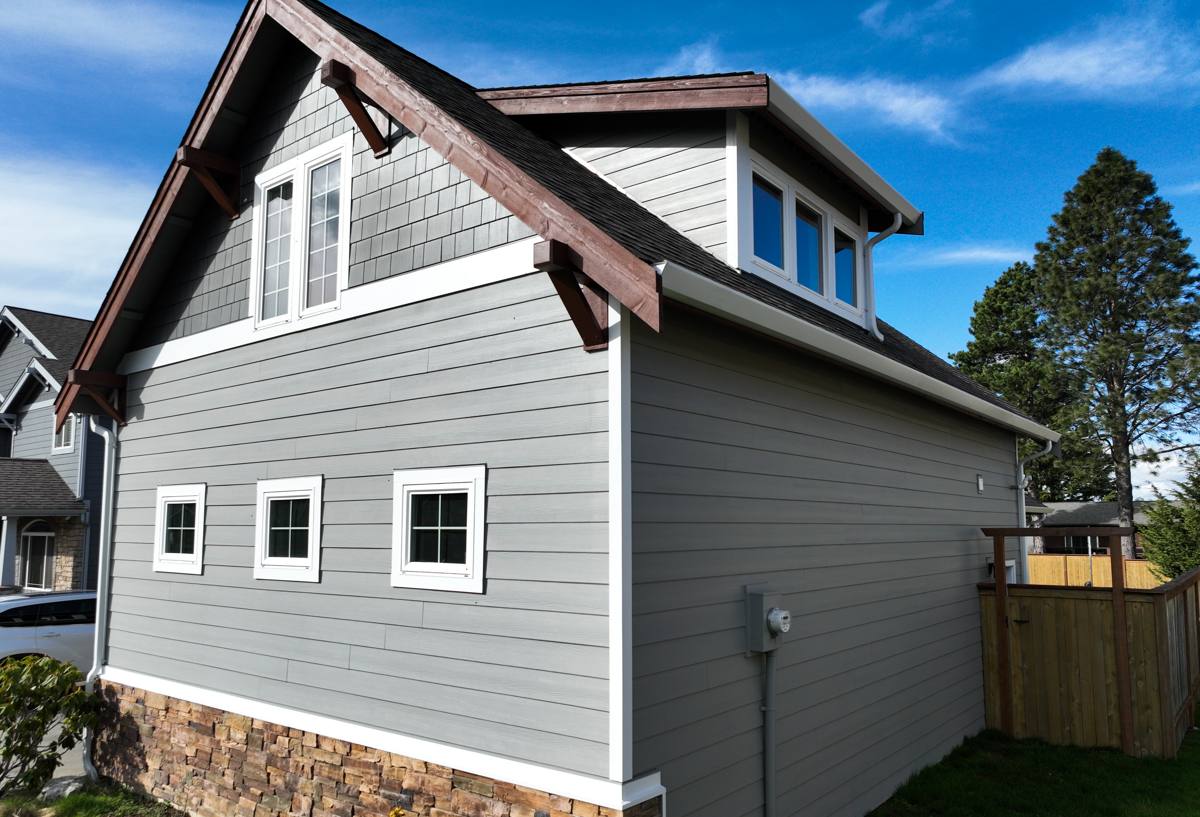
James Hardie fiber cement is cement, sand, and cellulose fiber — it's non-combustible, it doesn't soften in heat, and it doesn't feed termites or other wood-boring pests the way wood-based products can. Hardie engineers specific product lines for humid, storm-exposed climates like ours, referred to as HZ5 formulations, which are built to resist moisture-related damage in exactly the conditions Tampa Bay produces. The ColorPlus factory finish is baked on under controlled conditions and backed by its own finish warranty, which matters directly with our UV load — it holds color significantly better over time than field-applied paint on other materials. Hardie also backs its products with a strong transferable limited warranty, which carries real value if you sell the home down the road.
None of that replaces correct installation. Fiber cement performs the way it's rated to perform only when it's fastened, flashed, and caulked to manufacturer spec — that's true of any siding material, and it's where a lot of the real-world failures actually originate.
Comparing the Common Options
| Material | Wind/storm durability | UV/color retention | Moisture & pest resistance | Typical upkeep |
|---|---|---|---|---|
| James Hardie fiber cement | High, when installed to spec | Strong — factory ColorPlus finish | Non-combustible, doesn't feed pests | Low — periodic cleaning, no repainting for years |
| Vinyl | Moderate — prone to cracking, blow-off | Fades and chalks with age | Doesn't rot, but seams can trap moisture | Low, but limited fix options once damaged |
| LP SmartSide / engineered wood | Moderate — depends on sealed edges | Fair, coating-dependent | Vulnerable if coatings fail | Moderate — edge sealing, inspection |
| Cemplank / Allura fiber cement | High | Good, varies by finish | Similar profile to Hardie | Low to moderate |
| Primed spruce / cedar | Lower — wood movement under wind load | Weakest — needs repainting | Highest pest/rot risk | High — regular repainting, sealing |
How Our Local Installation Process Works
Every job on a Town 'n' Country home starts with an honest look at what's actually there — the age and condition of the existing siding, the state of the sheathing underneath, and any signs of past moisture intrusion around windows, doors, and roof lines. We don't cover up problems with new siding; we address them first.
- On-site inspection and measurement, including a check of trim, flashing, and any areas with visible wear or prior water staining
- Removal of old siding and inspection of the sheathing and house wrap underneath
- Repair of any damaged sheathing before new material goes up
- Installation of a proper weather-resistive barrier and correct flashing at every window, door, and penetration
- Fastening and installation of Hardie siding to manufacturer specifications for our wind zone
- Detailed caulking and sealing at joints, corners, and trim
- Final walkthrough so you know exactly what was done and what to expect going forward
Because Hardie siding is heavier and requires specific fastening patterns and clearances to perform correctly in high-wind zones, installation quality is not something to shortcut. That's a big part of why we keep our process consistent from job to job rather than treating every install as a one-off.
Why a Local Crew Matters Here
Hillsborough County's building codes and wind load requirements reflect the real storm risk this area faces, and a crew that works here regularly knows those requirements without having to look them up mid-project. Local experience also means recognizing which parts of a Town 'n' Country home tend to take the most weather exposure — south and west-facing walls that catch the most sun and driving rain, areas near mature trees where debris and moisture linger, and older homes where the original siding or flashing details may not meet current wind standards. A crew that only occasionally works in coastal, storm-prone climates is more likely to miss those details than one that deals with them every week.
Beyond Siding: The Rest of the Exterior
Siding doesn't work in isolation — it's one part of a home's overall weather envelope, alongside the roof, windows, and any attached structures like decks. A roof with aging flashing or a window with a failing seal can undermine even a well-installed siding job by giving water another way in. Tampa Siding Co. handles siding, roofing, windows, and decks, which lets us look at a home's exterior as one connected system rather than a series of disconnected repairs, and flag issues in one area that could affect another.
Cost Factors to Expect
Every home is different, but a few factors consistently drive the cost of a siding project in this area:
| Factor | Why it matters |
|---|---|
| Home size and wall complexity | More corners, dormers, and trim detail mean more labor and material |
| Condition of existing sheathing | Rot or moisture damage found during tear-off adds repair scope |
| Siding profile and finish selection | Lap width, texture, and ColorPlus color affect material cost |
| Trim and accessory work | Fascia, soffit, and trim replacement alongside siding changes total cost |
| Access and site conditions | Tree cover, fencing, and lot layout can affect labor time |
We give straight, itemized estimates so you know what's driving the number, rather than a flat quote with no explanation behind it.
Get a Free, No-Pressure Estimate
If your Town 'n' Country home's siding is showing its age, or you just want an honest read on where it stands, we're happy to take a look. There's no pressure and no obligation — just a clear assessment and a straightforward estimate using the form below.