 Tampa Siding
 Why Davis Islands Decks Wear Out Faster Than Most
Davis Islands sits right on the water, and that location is exactly why decks here age differently than decks a few miles inland. A deck on or near the island isn't just dealing with Florida sun and rain — it's dealing with near-constant salt air off Hillsborough Bay, tidal humidity that keeps wood and hardware damp longer, and direct exposure to whatever comes off the water during a storm. Add in the intense, nearly year-round UV that every home in Hillsborough County contends with, and you have a structure that's aging on multiple fronts at once.
Most decks don't fail because the decking boards wear out first. They fail underneath — at the ledger board, the fasteners, the footings, and the framing connections — long before the surface looks bad enough to worry most homeowners. On a waterfront lot, that hidden deterioration moves faster because salt-laden air corrodes metal hardware and accelerates wood decay in ways that inland properties simply don't experience at the same rate.
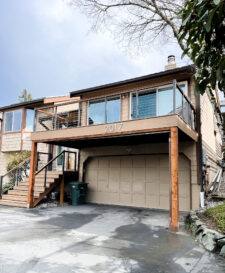
What a Waterfront Deck Actually Needs
A correct deck replacement on Davis Islands isn't just about picking attractive decking boards. It starts with the structure underneath and works outward:
Corrosion-Resistant Fasteners and Hardware
Standard galvanized screws and joist hangers can start showing rust within a couple of seasons this close to the bay. We spec stainless steel or marine-grade coated fasteners and connectors for waterfront and near-waterfront replacements, because the cost difference upfront is small compared to the cost of tearing a deck apart again in five years.
Proper Ledger Attachment and Flashing
Where the deck attaches to the house is the single most common failure point we find, especially on older homes. Wind-driven rain gets pushed sideways into that joint during storms, and if the original flashing wasn't installed correctly — or has failed over time — water tracks into the house framing, not just the deck. A replacement is the opportunity to correct this properly, not just re-attach to the same compromised connection.
Footings Sized for Local Soil and Wind Loads
Barrier and near-shore soil conditions aren't the same as inland lots, and homes exposed to open water see higher uplift and lateral wind loads during hurricane-force events. Footings and post connections need to be sized accordingly, not just matched to whatever was there before.
Drainage That Doesn't Trap Moisture
Decking gaps, joist tape, and grading underneath the deck all affect how quickly water gets away from the structure after Florida's frequent afternoon storms. A deck that holds moisture against wood framing is a deck that rots from the inside regardless of how good the surface boards look.
Choosing the Right Decking Material for This Location
There's no single "best" decking material — there's a best material for your specific home, budget, and how much maintenance you're willing to do. For a waterfront property, we weigh salt exposure and UV a little more heavily than we would inland.
| Material | How It Handles Salt Air & UV | Maintenance | Typical Lifespan |
|---|---|---|---|
| Pressure-treated wood | Needs regular sealing to resist salt-driven moisture and graying from UV | Annual cleaning and re-sealing recommended | 10–15 years with upkeep |
| Capped composite | Strong resistance to salt and fading; cap layer blocks moisture absorption | Occasional washing, no sealing or staining | 25+ years |
| Tropical hardwood | Naturally dense and rot-resistant, but still needs oiling to prevent UV graying | Periodic oiling to maintain color and moisture resistance | 20–25 years with upkeep |
| PVC decking | Excellent moisture and salt resistance; fully synthetic, no wood fibers to absorb water | Lowest maintenance of the group | 25–30 years |
We don't push one product on every homeowner. Pressure-treated wood still makes sense for owners who want the lowest upfront cost and don't mind the maintenance schedule. Composite and PVC cost more initially but make the most sense for owners who want to spend their weekends on the water instead of on deck maintenance — a trade-off worth discussing honestly rather than assuming.
Our Deck Replacement Process
- On-site inspection — We assess the existing deck's framing, ledger connection, footings, and any signs of water intrusion into the house itself, not just the deck surface.
- Full tear-out — Old decking, railing, and any compromised framing come out completely. We don't build a new surface over questionable structure.
- Structural correction — Ledger flashing, joist hangers, footings, and framing are brought up to a standard that accounts for this location's wind and moisture exposure, not just code minimums.
- Decking and railing installation — Installed per manufacturer spacing and fastening specs, which matter more in humid, salt-air conditions where expansion and contraction are more pronounced.
- Final walkthrough — We review the finished deck with the homeowner, including care instructions specific to the material chosen.
Permitting and Code Considerations
Deck replacements in Hillsborough County typically require a permit, and waterfront and near-waterfront properties can carry additional considerations depending on flood zone designation and elevation requirements. Railing height, guard spacing, and stair requirements are also code items that get missed on older decks that predate current standards. We handle the permitting process as part of the job rather than leaving it to the homeowner to sort out, and we build to current code rather than simply matching whatever existed before — especially on a structure this exposed to storm conditions.
What We Commonly Find on Older Davis Islands Decks
- Rusted or corroded joist hangers and fasteners hidden under intact-looking decking boards
- Ledger board attachment with missing or failed flashing, sometimes with water damage already tracking into the house rim joist
- Undersized or shifted footings that were never adequate for the wind exposure of an open-water lot
- Railing systems that no longer meet current height or spacing requirements
- Wood decking that looks fine on top but is soft or spongy underfoot near the house or stair connections
- Standing water or poor drainage underneath the deck contributing to ongoing rot
None of these are unusual for a deck that's been through several Florida storm seasons — they're exactly what we expect to find and plan for when we scope a replacement here.
Cost Factors Homeowners Should Understand
Every deck replacement quote should reflect the specific conditions of the property, not a flat per-square-foot number. The factors that move the price up or down the most on a waterfront job are:
| Factor | Why It Matters Here |
|---|---|
| Extent of framing/footing repair needed | Salt air accelerates hidden corrosion and decay, so older decks often need more structural work than they appear to |
| Decking material selected | Composite and PVC cost more upfront but reduce long-term maintenance in this climate |
| Fastener and hardware grade | Marine-grade stainless costs more than standard galvanized but resists salt corrosion far longer |
| Deck height and railing complexity | Elevated decks and multi-level layouts require more structural work and code review |
| Permitting and flood zone requirements | Waterfront properties can involve additional review depending on elevation and zone |
Simple Maintenance That Extends the Life of a New Deck
- Rinse salt residue off the deck surface periodically, especially after windy days off the water
- Keep gutters and downspouts clear so runoff isn't dumping extra water onto or near the deck
- Check railing posts and stair connections once or twice a year for movement
- Reapply sealant or oil on wood or hardwood decking on the schedule the manufacturer recommends
- Clear debris from underneath the deck so airflow and drainage aren't blocked
Why Hire a Crew That Already Works Davis Islands
A deck replacement on an island lot has logistics an inland job doesn't: limited staging space, bridge access for equipment and material delivery, and often tighter lot lines than a typical suburban property. A crew that's worked in the area knows how to plan a job around those constraints instead of figuring it out on the fly, which keeps the project on schedule and keeps disruption to neighbors to a minimum.
Just as important is understanding what this specific environment does to a deck over time. A contractor who mostly works inland may not think twice about standard galvanized hardware or a lighter footing design — decisions that hold up fine away from the water but shorten the life of a deck exposed to salt air and open-water wind. Local, water-adjacent experience shapes better decisions before the first board goes down, not just faster repairs after the fact.
If your deck is showing its age — soft spots, rust streaks from fasteners, railing that feels less solid than it used to — we're happy to take a look and give you a straight, no-pressure assessment of what it actually needs. Use the form below to request a free estimate for your Davis Islands deck replacement.